
When you die, leaving behind a Will you ensure that your assets are distributed as per your wishes. A Will prevails over the nomination. By writing a Will, you also ensure that the probability of disputes among your family members is reduced, and your heirs don’t have to go through the lengthy procedures for claiming their share of the legacy.
But what happens when you die without a Will? How will assets get distributed among your family members? Who gets what share? Will everything go to your spouse? Can any asset be claimed by your parents? Who takes care of the child’s share till they are minors? All such questions will arise. The answer is not simple, but there are specific laws created for such situations. The basic understanding of these laws gives you enough reason why there is a strong need to create a Will for a secure future for your family.
Let’s understand what happens to your legacy when you do not leave a Will behind –
The Indian Succession Act, 1925
When a person dies without making a Will, he/she is said to have died Intestate, in which case property is inherited by legal heirs according to the law of succession. The succession to the property of Hindus is governed by the provisions of the Hindu Succession Act, 1956, wherein different rules are applicable for Hindu males and females dying intestate. For succession of property in Muslims, there are Muslim laws, while for any person other than Hindus, Muhammedan, Buddhist, Sikh, or Jai,n the succession to property is governed by the Indian Succession Act, 1925. Here, I have limited my discussion on succession to property in Hindus.
The Hindu Succession Act, 1956
This act applies to a Hindu, Buddhist, Jain, Sikh, or any person who is not a Muslim, Christian, Parse, or Jew. When a Hindu male member dies without a Will then the assets are distributed equally among the legal heirs. So whether it be your savings account, mutual funds, small savings schemes, property etc, your legal heirs will have an equal share in your assets. There can be various other acts, like the EPF Act, where nomination has a much larger role in succession planning. The Hindu Succession Act, 1956, has laid down the specifications on how the property will be distributed among your legal heirs.
There is one big misconception that by appointing a nominee for financial assets, we believe our estate plan is complete. But that’s just the beginning. In the eyes of law, a nominee is just a custodian of your assets. Though a nominee will receive the proceeds from the financial institution, he/she will have to transfer their share of the assets to the respective legal heirs.
Who Are the Legal Heirs?
The larger question is who actually are the legal heirs in the eyes of law who can claim your assets. A general perception is that your spouse will get everything or your children will inherit your legacy after you. But that’s not so. Under the Hindu Succession Act, all your legal heirs are classified under Class I or Class II. The first right on your assets will be from Class I heirs. In case there is no one alive from the Class I List, then Class II legal heirs will bequeath your legacy. If they are also not present, then an Agnate or Cognate relationship comes into effect for a right in your assets. The priority is given to the relationships from agnate.
The list is long enough and has been clearly defined in the law. Given below is a chart that describes the legal heirs in Class I and Class II categories. The list also presents the sequence in which the assets are distributed among the legal heirs in these various categories.
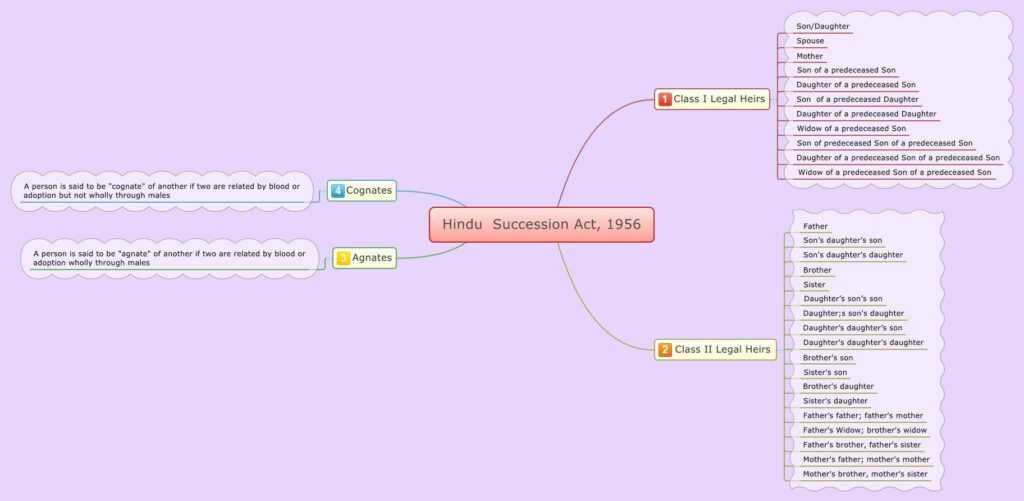
If you look at the chart closely, then it’s actually your mother, your widow, and your children who have the first equal rights over your assets. Your father comes in the Class II category of legal heirs. Only when no heir from the mentioned Class I list above is alive, the legacy is bequeathed by Class II heirs as per the illustrated list and so on.
Apart from this, there are special situations which can arise and where the law has a different say:
More than One Widow
Here, all the widows together will take one share of your property
No Legal Heir
In case there is no legal heir present, then the assets actually go to the Indian government
Unborn Baby
In law, an unborn baby has been treated as a different person, and so he/she have an equal share in your legacy
Inherited property
Assets inherited through a Will are treated as self-acquired properties, and so you can make a Will for further distribution. But if any property you have inherited through succession, then the same can’t be given away by Will, but will devolve upon the heirs entitled to such property under the Hindu Law if the deceased is Hindu.
There may be specific rules governing the distribution of assets in Class I or Class II or among agnate or cognate. One can get these specific rules from the Hindu Succession Act to be clearer.
Hindu Female
Much like the Hindu male, succession of Hindu female assets is also clearly specified in the Succession Act. If a female Hindu dies without a Will, then her assets will be distributed as follows-
- Firstly spouse and children will share equal rights
- If none are alive, then the legal heirs of her spouse will be the actual heirs of her assets
- If none is present, the parents of the deceased woman will claim the assets
- If all legal heirs mentioned above are also not present, then the legal heirs of her father will inherit the assets
- If none are alive, then the assets will go to the legal heirs of her mother
Thus, there are specifications which have been laid down in the Hindu Succession Act, 1956, and which need common attention. But the absence of a Will also invites larger disputes, especially when the are more family members. These disputes go on for years, and the family, especially loved ones who need the most, gets deprived of the legacy you wish to leave for them. There is no recourse then, and the only way you can protect yourself from such a situation is to make a proper Will and nominee in your assets. More than that, awareness of the law ensures you are making the right provisions for your family