
When forming a private trust for a special needs child, lifelong care the most difficult aspect parents have to address is finding a reliable trustee. Mostly, the next trustee after parents is one of the family members. But that’s not enough. A trustee has to be someone who is adapted to managing accounts, Bills, taxes, and other financial matters, and at allocating money to these needs in an efficient manner. More than this, the trustee must be someone committed to the beneficiary’s interest and needs.
Finding an ideal trustee is nearly impossible. The trustee must have many qualities and have to dedicate themselves entirely to the needs of someone else. Also, they must think beyond their interest and probably to life after them.
It’s hard to find such a resourceful person. The family members may or may not understand the role of a trustee, or may not be competent. The most challenging work in front of parents is how to identify who can be a good trustee for a trust created for their child. The trustee must have some qualities associated with managing the affairs of a trust.
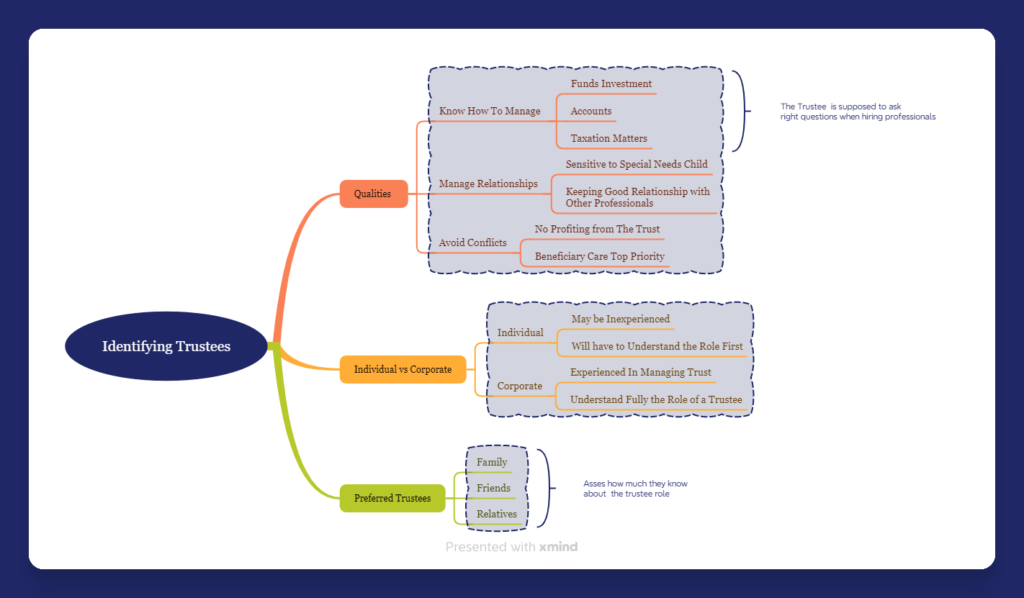
Here are five factors to consider while identifying a suitable trustee:
Competence, Knowledge and Experience
A trustee should be competent enough to manage financial affairs. The trustee has to oversee how the funds to be invested and where, whether to be more aggressive or stay conservative for investments and many others. The trustee also has to consider managing books of the accounts of the trust, handle taxation matters and mange investments of the funds. Though a trustee is not supposed to be expert in all these matters, he/she should be aware of how to meet this requirement, like as hiring a professional advisor; the trustee should be knowledgeable enough to ask the right questions. Choosing among the family members has one disadvantage, that he/she may not be experienced enough to handle trust matters and so will need time to understand.
Conflict of Interest
The conflict of interest in a trustee arises when the trustee starts thinking about his profits from the trust. In an ideal situation, the trustee should be people who can put the beneficiary’s interest at the top. Though this is easier said than done, the provisions in the trust deed are created to safeguard this aspect. The law under the Indian Trust Act 1882 also puts this rule as primary under the duties of a trustee.
Personal Connections
The trustees are going to work for the beneficiary, and so it’s important that they understand his/her requirements well. Many personal situations will arise when trustees may have to communicate with the beneficiary for certain reasons. The trustee-beneficiary relation is critical for the success of any private family trust. Hence, the trustee should be made aware of the beneficiary’s situation, and a healthy relationship should be maintained. The understanding of the trustee will decide how this relationship emerges.
Individual vs Corporate Trustees
Managing a trust requires commitment, especially if it’s a special needs trust. If all trustees are identified as individuals, then it has to be seen how they will bring changes to their lives. If these individuals are taking responsibility of a trustee for the first time, then there are more chances that they will need an understanding of the role. Contrary to this professional trustee may be well experienced to manage the affairs of the beneficiary. Another aspect that has to be considered is the continuity of trust functioning in both scenarios. Thus, while appointing trustees, both options have to be looked at, and what benefits for the family trust should be considered.
Family and Friends as Trustee
Though most families prefer friends and other family members as successor trustees, the success cannot be guaranteed. This is because the trustee is well-intentioned, but the lack of knowledge and awareness is the direct result of their failing to play the role of the right trustee. Professional trustees have outperformed family members since they have adequate knowledge and experience. It may also lead to a reduction in confrontation among the members.
Having said that, family members may still be the best choice in a smaller trust. But trusts which have large corpuses to manage will find professional trustees better equipped to handle the job. For a special needs trust where parents themselves become the initial trustees, the decision of family members or a professional trustee may come later. Even if the professional trustee is involved, the family members have to be there in a guiding role, which can come through by forming a trust advisory committee or appointing a protector or care manager, or they involved as co-trustees.
A trustee has to be prudent enough to manage the affairs of the trust for the benefit of the beneficiary. The trustee should also understand the regulations and how to work around them. Moreover, the trustee should be well versed in the utilization of funds from the trust and in managing the books of accounts. The trustee doesn’t need to be an expert in financial aspects, but he/she should know how to manage these and what kind of professionals to hire.