
When you have a special needs child care there is a concern of providing for the child’s lifelong care irrespective of what happens in your life. Considering the high expenses involved in child care, there are numerous uncertainties in life that can arise. In such a case, a private trust is the most viable option for families to ensure the care of the child remains financially secure.
But identifying how much to fund the trust is not an easy task. Though there are free calculators available online to determine corpuses, there is none for a special needs child. Hence, garnering the support of a financial planner who has expertise for your situation will do well.
Parents are aware that a child with special needs can generate multiple expenses. Exactly how much these expenses are will depend on the needs and lifestyle of the family, along with the abilities of the child. Most of these expenses will be variable as they may change with the child’s life stages. However, one of the highest costs is housing if parents decide that the child will live in a private house of his own after the parents’ lifetime. For example, a 2 bhk in a city like Noida costs anything between Rs 80-90 lakh. Then there will be additional monthly costs for care like food, utilities, and staffing. Then add any budgetary expense for membership, weekly outing etc. A budget sheet gives a clear picture of how much parents spend on child care.
The budget will increase when parents pass away. When parents are alive then most of the care is taken by them. When they are not alive, then all their work will be monetized. For example, coordinating care for the child will be handled by a professional who will incur a cost. This cost will arise once the trust starts funding in the absence of parents. Other costs like ITR, audit after a certain threshold, legal and administrative costs etc., will kick in. Even if there is a family member as a sole trustee, every year, lawyer assistance may be sought to ensure the benefits are not jeopardized.
Let’s take an example and understand how much you actually have to put in the trust of your child’s care. We will take a budget for a fictitious child, “Vicky,” who is a special needs child. Here we are determining what is the corpus required for his care is when parents pass away, and then what’s the total corpus required by the trust to cover all expenses. We assume his life expectancy to be 80 years, and parents’ life expectancy to be 85 and 90 years for father and mother. Here, Vicky lives beyond 20 years after her mother passes away at 90. At this stage, Vicky will be 60 years of age. Assuming the money grows at 8% and inflation is 7%. Vicky’s family has to provide to trust a corpus of Rs 1.4 cr for Vicky’s lifetime.
The charts below illustrate how this corpus has been arrived.
The Hypothetical Expenses for Vicky’s Care
Before the Death of Vicky’s Parents

This cost will shoot up if Vicky’s care is run professionally 24/7.
Expenses after Vicky Parents Death
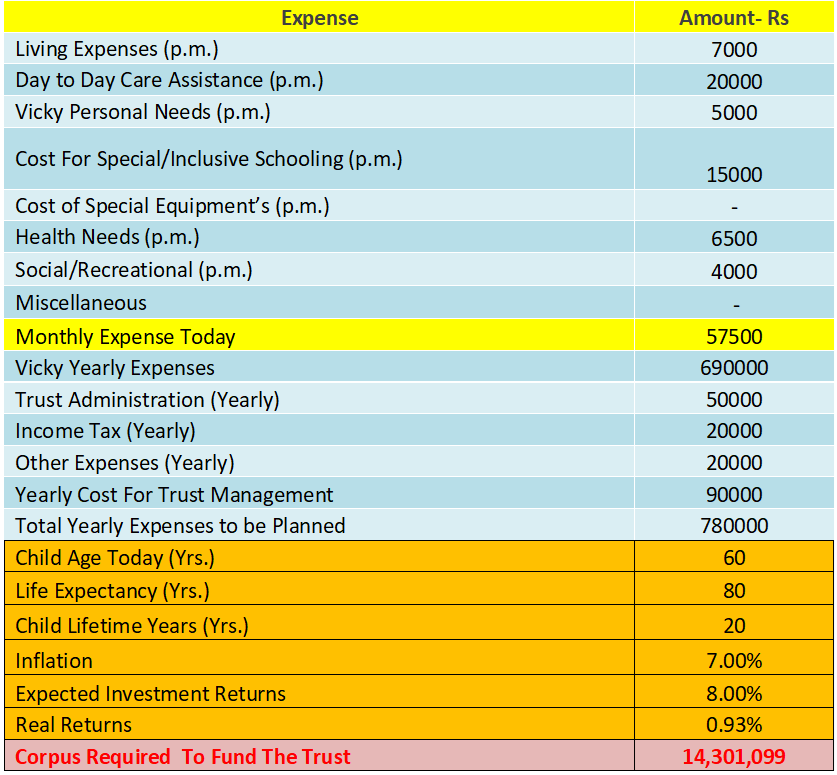
The administrative cost of running the trust and professional fees will all be borne by the trust.
As you can see on the above charts, the monthly expense for Vicky amounts to Rs 38500 p.m. Add to these the trust administration cost, the monthly expenses to be planned after the parents are approximately Rs 77500. To manage this till Vicky’s lifetime, parents will have to ensure they leave behind a total corpus of Rs. 1.4 crore to be funded to the trust.
Planning Is Inevitable
The key takeaway from this analysis is that parents have to plan well in advance to fund the trust with the right amount of money. Not many parents will have an inheritance or surplus today. It is important that parents do a complete analysis of the child’s requirements. Once this is identified, parents will have to start saving and make adjustments in the cash flows for any shortfall. To achieve this, a beginning has to be made to start analyzing your special needs child’s future requirements.